Fulfillment Center vs. Warehouse: Differences
Fulfillment center vs. warehouse side by side: purpose, layout, technology, pricing and which fits an ecommerce business.

Key takeaways
- A warehouse stores goods; a fulfillment center fills individual orders.
- Pricing differs: per space vs. per order plus storage.
- Choose by order profile: bulk vs. many small parcels.
- Some brands use both with a clear transfer process.
On this page
A warehouse stores goods, often in bulk and for long periods. A fulfillment center stores goods too, but its main job is to process many small customer orders quickly: picking, packing, shipping and handling returns. The two overlap, and many sites do both, but the layout, systems and pricing differ.
Side-by-side comparison
| Warehouse | Fulfillment center | |
|---|---|---|
| Main purpose | Storage, often long term | Fast order processing |
| Typical movements | Pallets and cartons, in and out | Individual items and small parcels |
| Recipient | Retailers, distributors, other sites | End customers |
| Layout | Dense racking for storage | Pick locations, packing stations, shipping area |
| Technology | Inventory control | WMS, order integrations, scanning, shipping software |
| Returns | Not usually handled | Core part of the service |
| Pricing | Per pallet or space | Per order plus storage and extras |
| Best fit | Bulk or long-term storage | Frequent online orders |
What a warehouse does
A warehouse receives goods, puts them away, keeps them safe and releases them when needed. Orders are usually large: pallets to a store or to another warehouse. Staff handle few, heavy movements, and the systems focus on stock levels and locations.
What a fulfillment center does
A fulfillment center runs the whole order cycle for online sellers: receiving, storage, picking, packing, labeling and shipping, plus returns and extras such as kitting. Everything is organized around many orders per day, each containing a few items. See what a fulfillment center is.
Which is better for your business
Choose a warehouse when
- You store large volumes for long periods, for example seasonal stock or raw materials.
- You ship pallets to retailers or move stock between locations.
- You do not need pick and pack for individual customers.
Choose a fulfillment center when
- You ship many small orders to customers.
- You sell online and need integrations and tracking.
- You want returns, kitting and custom packaging in one place.
Can you use both?
Yes. Some brands keep bulk or slow-moving stock in a warehouse and replenish a fulfillment center in smaller lots. Others use one provider that offers both. Check the transfer process and its cost, because each movement between sites adds handling.
Where a distribution center fits
A distribution center moves large quantities of goods to stores, wholesalers or other facilities. It sits between a warehouse and a fulfillment center: more flow than storage, but oriented to bulk shipments, not single parcels. See ecommerce distribution centers.
Questions to ask a provider
- Do you handle single-order pick and pack, or only pallet shipments?
- How are storage and handling priced?
- Which store and marketplace integrations do you support?
- How do you receive inventory and report discrepancies?
- How do you process returns?
Compare answers using how to choose a fulfillment provider and fulfillment costs. For storage with fulfillment, see E-commerce Warehousing Solutions.
How Ecom Auto Prep supports fulfillment and storage
We provide storage and order fulfillment from one site in Florida. See E-commerce Warehousing Solutions and Direct-to-consumer fulfillment.
Layout differences
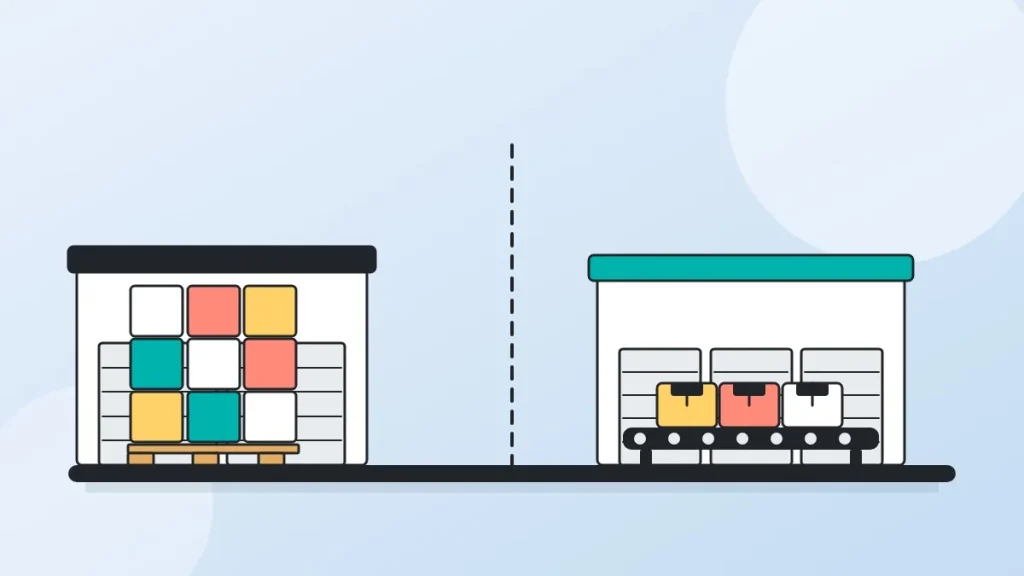
A storage warehouse is laid out to hold as much stock as possible, often in pallet racking. A fulfillment center is laid out for fast order work: pick locations close to packing stations, clear zones for receiving, packing and shipping, and enough space for returns. Fulfillment centers often use cross-docking for freight that is already allocated to orders, which skips long-term storage.
- Pallets in, pallets out
- Space-based pricing
- Few orders, large lots
- Orders in, parcels out
- Per-order and per-item pricing
- Pick, pack, ship and returns
How the daily work differs
| Activity | Traditional warehouse | Fulfillment center |
|---|---|---|
| Inbound | Pallets received and stored | Pallets and cartons received, counted by SKU and put away to pick locations |
| Outbound | Pallets and cartons released in bulk | Individual orders picked, packed and shipped to consumers |
| Order data | Often a shipment document | Orders arrive from your store through an integration |
| Returns | Rarely handled | Inspected, restocked or disposed of by rule |
| Speed expectations | Days to weeks | Same-day or next-day processing is common |
The main difference is that a warehouse keeps stock, while a fulfillment center moves stock to customers one order at a time. A fulfillment center usually includes storage, so it covers both jobs.
Cost structure compared
Warehouse pricing is usually based on space: a rate per pallet or per square foot, plus handling in and out. Fulfillment pricing adds per-order work: pick and pack fees, packaging, and shipping labels. Because the cost models differ, comparing a warehouse quote with a fulfillment quote on one number leads to wrong conclusions.
Build the comparison from your own figures: monthly orders, items per order, average stock in pallets and returns. Our fulfillment costs guide shows how to calculate the total cost per order.
Signs you have outgrown a warehouse-only setup
- You or your team pack orders in the evenings or on weekends.
- Stock counts in the storefront do not match what is on the shelf.
- Orders ship late during promotions.
- Returns pile up because nobody has time to process them.
- You sell on several channels and track stock in spreadsheets.
If three or more apply, the work is no longer storage. It is fulfillment, and it needs order data, scanning and a defined process. See how warehouse management systems keep stock accurate.
Frequently asked questions
What is the main difference?
A warehouse stores goods. A fulfillment center fills individual customer orders.
Can a warehouse fulfill ecommerce orders?
Some do, but many lack the systems, layout and integrations for high volumes of small orders.
Is a fulfillment center more expensive?
It costs more per unit stored because it includes labor for each order, but for online sales it replaces work you would otherwise do yourself.
Should an ecommerce business use a warehouse or fulfillment center?
If most orders go to individual customers, a fulfillment center. If you mainly move bulk stock, a warehouse.
How is a distribution center different?
It moves bulk goods to stores or other sites, not single parcels to customers.
Anton Kashirin
Anton founded EcomAutomation, the company behind EcomAutoPrep. He works with Amazon FBA sellers and DTC brands on receiving, prep, kitting and shipping, and reviews the guides on this blog against how orders move through the warehouse.